Seen on the Road
Like most things fish-related, local halibut has a mighty back story. We sell, eat and recommend Inside fish, but on the coast the Quinault, Quileute and Makah tribes engage in a much larger volume halibut fishery at the same times as the Inside tribes. The Outside fish are smaller, more abundant and lack many of the toothsome traits of their Inside relations. The difference is most likely due to diet and water conditions--the San Juans have such tremendous water flow that every marine species caught here is the acme of it's type--this holds for finfish, shellfish and crustaceans.
Fish Is War.
Quota for everyone, Alaskan, Canadian, Tribal and sport, is set by the International Pacific Halibut Commission. The tribes may only harvest halibut to the quota set by IPHC scientists. They may schedule the fishery to their own liking. However, they must all agree amongst themselves. This is a tall task, given the sums of money at play, the importance the tribes place on their fisheries, and the power-plays of honky fish managers and lawyers, plus the huge disparities in wealth between the central-I-5 "Casino tribes", and the Western and Northern, more fish-dependent tribes and again the disparities based on access to various fisheries resources, including hugely lucrative geoduck fishery. "All Diplomacy,." in the words of Zhou Enlai the first Premier of Red China, "Is Continuation of War by Other Means". And this nugget is a play on the Von Clauswitz quote, "War is the Continuation of Politics by Other Means" In Washington State, "Fish is the Continuation of War by Other Means", whether we are talking Tribal, State-Licensed or Sport fishers, not to mention environmental groups, farmers and loggers, and certainly state and federal bureaucracies.

Everyone Fights Over Fish.
U&A Means Opportunity.
After the 1974 Boldt Decision, which codified the tribes' right to 50% of fish resources in Washington State, each tribe was required to set and verify their rights to fish in given areas, based on evidence of historic usage. These zones are known as "Usual and Accustomed Areas" (U&A) parroting language in the treaty. So the S'Klallam tribes, for instance, may fish out to Neah Bay but no further, throughout the San Juans, but not farther north than the northern tip of Orcas Island. They may also fish in Hood Canal, but are barred from the lower Puget Sound South of a line drawn between Edmonds and Kingston, and East of the opening to Possession Sound. The tribes are constantly contesting one another's U&As, with the most dramatic change of recent years being a federal court barring the Lummi Nation from fishing the Straits south of a line drawn one mile south of Lopez and San Juan Islands and run East to Biz Point on Fidalgo Island. The rationale for this was a finding that judge Boldt erred in granting Lummi this area with little concrete evidence of historic usage. The real driver here, though was that the Lummi Navy, the largest, best equipped and professional fishing fleet on the Inside was dominating the fishery to the point that other tribes were more or less shut out. The Lummis still, however, maintain rights to fish in Area 9, which runs South of a line from Point Wilson at Port Townsend to Partridge Point on Whidbey and North of a line between Edmonds and Kingston and West of a line from the Southern tip of Whidbey to the Snohomish county shoreline. As the Lummis sourly point out, how does the Judge think the Lummi ancestors made it to area 9 without passing through the now-forbidden Southern Straits district? Area 9 is rich in crab, geoduck, urchins and cukes, and is the constriction point for all the South-Sound Puget Sound salmon, but because the Lummi have access to area 9, the Southern tribes and WDFW refuse to allow an area 9 salmon fishery. And every year the Lummis threaten to unilaterally open for coho and chum salmon in area 9.....War by other means.....

It only gets more complex from here.
Halibut Hi-Jinx--Cry Havoc!!!
Typically the Washington tribes open their fishery on the first day of the season, this year being the 11th of March. This guarantees the highest pricing of the year, as our local halibut hit the market crucial hours before the first Alaskan or Canadian fish can. So Salish Sea Halibut is not only the best of the year, it is typically the first of the year. This first fishery is an unrestricted derby fishery, meaning that fishers may land as much fish as they like. Subsequent openers occur around other fisheries and are typically limited to 300-500# per boat. Outside tribes like to stretch out the limited fishery so as to be able to retain halibut in their targeted black cod fishery.
This year saw a string of bad weather forecast for the early days of the halibut opener. Inside tribes would have chosen to fish anyway and take their chances with the weather to take advantage of the high prices. Outside tribes were more conservative, and the fishery was delayed from March 11. That entire week actual weather conditions dramatically under-performed forecasts. The Makah were willing to take a flyer on the weather, but the Qulieute refused to budge and the Quinault backed them up. The Inside tribes, watching time, good tide series and markets slipping away, decided to buck Quileute and go fishing. An opener was called for Monday the 20th from 7:00am 'till midnight Tuesday. Roughly 150 boats from Lummi, Nooksack, Swinomish, Tulalip, Suquamish, and the S'Klallam tribes, Port Gamble, Jamestown and Elwha hit the water. Each boat spends at least $1000 in bait with fuel, gear and other expenses adding up higher yet. Crab is always slow through the deep-winter months and the halibut fishery marks the first big financial bump of the spring season. Our last Monday was spent burning up the phone lines as we lined up fish logistics, moved last-minute bait around and fielded pricing chatter. Catches were strong on the first few picks. Meanwhile, Quileute went to court. At roughly 2:30pm Federal Judge Ricardo Martinez ordered the fishery closed by injunction, with all hooks required to be out of the water by 6:00pm Monday. Judge Martinez further ordered the tribes to come up with a revised plan to present to him April 15. In the interim the halibut, and all related fisheries are to remain closed. This includes black cod, the biggest money of any coastal fishery.
Predictably, the inter-tribal back and forth has gotten very heated. Many of our sources in the tribal-politics world are scratching their heads over this one: Quileute has the smallest and least-productive fleet of the coastal tribes. By some counts they field no more than eight boats for the halibut fishery. They are also the most remote and likely the poorest of all the Western WA tribes. In this instance, Quileute has decided to play the spoiler. Maybe it is simply the weather, or maybe, behind closed doors, the Quileute are pushing some other issue, far from prying F.O.G. eyes and ears, by means of stalling fisheries worth tens of millions of dollars. War by other means............
BREAKING NEWS!! In a subsequent ruling, in consideration of all tribes coming to agreement, Judge Martinez has allowed fisheries to proceed effective 7:00am Weds the 29th. As of now the tribes are planning a Thurs/Friday opening. We're going fishing again!!!!!!!!!
Predictably, the inter-tribal back and forth has gotten very heated. Many of our sources in the tribal-politics world are scratching their heads over this one: Quileute has the smallest and least-productive fleet of the coastal tribes. By some counts they field no more than eight boats for the halibut fishery. They are also the most remote and likely the poorest of all the Western WA tribes. In this instance, Quileute has decided to play the spoiler. Maybe it is simply the weather, or maybe, behind closed doors, the Quileute are pushing some other issue, far from prying F.O.G. eyes and ears, by means of stalling fisheries worth tens of millions of dollars. War by other means............
BREAKING NEWS!! In a subsequent ruling, in consideration of all tribes coming to agreement, Judge Martinez has allowed fisheries to proceed effective 7:00am Weds the 29th. As of now the tribes are planning a Thurs/Friday opening. We're going fishing again!!!!!!!!!

Nobody, I mean NOBODY goes fishing 'till I say so
.
Salish Sea Halibut, JFF and You.
Despite the train-wreck-like nature of the opener, we managed to secure 11000# of beautiful, large, inside halibut. The bulk of these fish are lovingly rat-holed, in beds of crushed ice, at at a secure location in South Seattle. We are carefully metering out these precious fish to make them last as long as possible. Remember, halibut is one of the few fish that actually improve with age--at least up to a certain point. Back in the halibut schooner days of 6-week return trips from Seattle to the Gulf of Alaska or Bering Sea grounds, the old-time crewmen made a point of pulling fish from the bottom of the hold for their homepack. So treated with age, cold and weight pressure, halibut turns mildly yellow, the texture firms up and the flavor rounds out, something like a fine aged gouda. We have experimented with this, and have found aged halibut to be one of the finest seafoods we have ever eaten. We don't push it this far for sale to you, but the point is: don't be afraid to purchase and sell well-handled halibut that is up to three weeks out of the water. We will have Salish Sea Halibut throughout the next few weeks. We will always be the first and last in the market with local fish. Even with the best of intentions, though, it is just a few fleeting weeks of the best halibut in the world. Once they are done and gone, this, we will return, with a sigh, to Alaskan or Canadian product until next year, weather permitting, and judge allowing.
Halibut Market Report.
Halibut used to be a cheap fish. Back in the day it was the choice of fish-and-chip restaurants and a favorite retail fish. In the past years, however, pricing has climbed to be one of the most expensive fish around and is strictly in the realm of fine dining. This year retail halibut started at over $30#. Halibut pricing has always baffled us, why, out of all the firm white fishes available, has halibut scaled the greasy pole to become a premium animal? A major part of it is likely the transition in Alaska from a derby fish to an IFQ, or Individual Fishing Quota, fish. This means that fishers own a small fraction of the resource, and can harvest their quota at any time within the IPHC mandated time window. This has allowed the bulk of halibut to go out to the world fresh, rather than the frozen-market focus of a volume derby fishery years. What Alaskan halibut does get frozen is generally from from the more remote reaches of the state and is a truly premium product, destined for high-end domestic, largely Eastern US markets. Across the pond in Russia, a substantial halibut fishery burns on with a frozen-focus. The lower end and food-service segments of our market are big users of Russian halibut. Also, the fishery has been steadily ratcheting down over the past 10 years as the Alaskan resource has cycled downward, constricting supply. Size and presentation surely has something to do with it as well--halibut are big and beautiful and fun to cut and play with--Pacific cod, a better tasting fish, in our opinion, are small, bony and a nightmare to process--we always end up badly slashed every time we try to work with whole p-cod. Halibut are an almost entirely domestic fish--there is practically no export market for them, and our friends in China get almost no Pacific halibut. So halibut are an America-First kind of fish, beloved across the land. with little appeal for foreigners. Now the resource and fishery are on their way back up in terms of volume. Where to for pricing?
Flatfish Rivals.
The Atlantic Ocean is blessed with two, roughly equivalent fishes. The Atlantic halibut and the Greenland halibut, or Hippoglossus hippoglossus and Reinhardtius Hippoglossoides. Iceland, Greenland, Norway and Russia are the primary harvesters of these fish. Greenland Halibut are harvested in huge numbers, the most recent figures we could find, for 2010, put the catch at a quarter of a billion pounds a year, five times the entire harvest of Pacific halibut, with harvest numbers certainly higher now. Atlantic halibut tally up closure to Pacific halibut numbers, but along with Greenland and Pacific hali, all these species are on the increase. Pricing for Greenland halibut is dramatically lower than for Pacific. The only published figures we could find were for frozen Greenland fish delivered into Japan for less than $4.00#. Greenland halibut has been a major import species for both China and Japan in recent years. This past winter, with increased abundance, harvests, aggressive pricing and the ongoing slow-down in Chinese and Japanese seafood imports, Greenland halibut has made major inroads in the American market. Major Alaskan processors report large volumes of frozen halibut still on hand, as expected sales to the East Coast did not materialize. As our fresh season has kicked off here, we are seeing a sluggish pipeline for halibut sales into these markets. Reports have it that the major fish processors are shipping fresh halibut into the Eastern states at well below cost to try and claw back some of the Eastern market share from the Greenland product. So fresh Pacific halibut offers are actually lower right now in New York than in Seattle. This situation will not endure, Pacific halibut must drop in price to compete with the Greenland. Processors are going to be skittish about freezing fish and adding to their inventories. So we expect mildly lower halibut pricing this year. Nothing dramatic, but with the ongoing ramp-up in seafood pricing, halibut will stand out as a relative value fish. We do, however, expect the usual price bump midsummer when the bulk of the Alaska fleet is chasing salmon.

Those Greenlanders Out-Fish and Under-Price us.
Scallop Photo of the Week!
Scallops continue to roll and continue to win new hearts and markets. Going forward every weeks' Fish-O-Gram will include the loveliest scallop photo forwarded to us that week. Keep 'em coming!
Pink Scallop Photo of the Week. Chef David Perez, Estatiorio Milos LV. Chef David, You have won an all-inclusive tour of the JFF shellfish hatchery or a 5# bag Lopez Island smelt, Your Choice!
Visitors from the Deep!
As we settle into a routine with scallops, one of the unexpected bonuses is the fine variety of deep-water fauna that ends up in the dive bags along with a healthy assortment of rocks and barnacles. Below are some of the highlights.
This is a Puget Sound King Crab, one of the most beautiful forms of life we have ever seen.
The Children are NOT dive-caught.
What an animal!
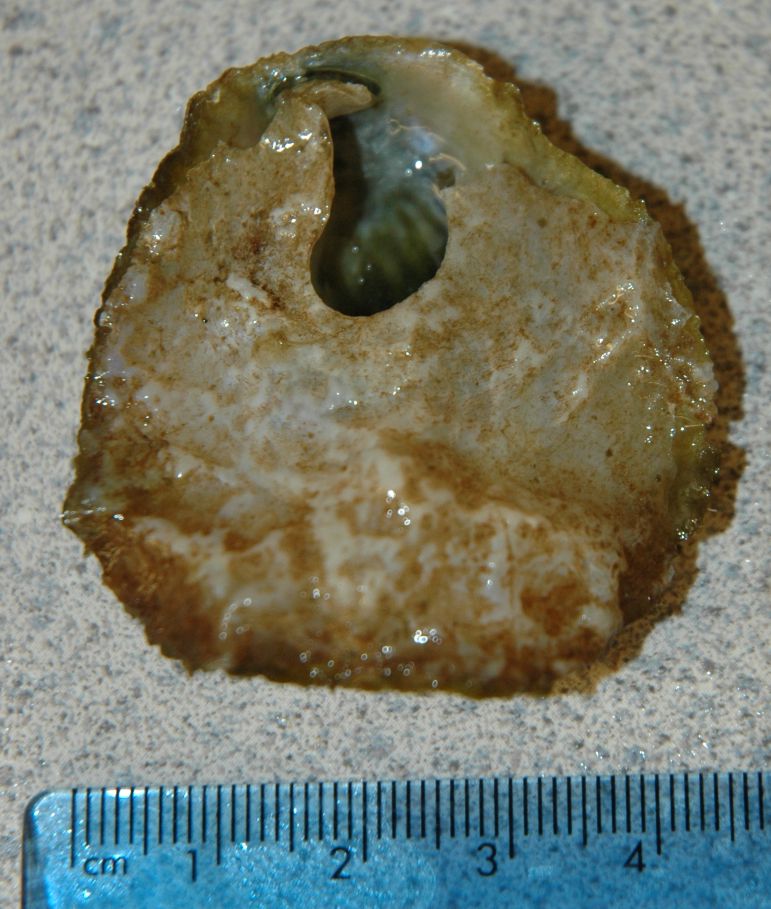
A jingle shell oyster. Edible, but nasty....
Another small crab. We don't know what it is.
Until next time we are your, Halibut-Beheading, Mermaid-Gawking, Court-Order-Following, Ice-Fishing, News-Breaking, Scallop-Fetishizing, Species-Identifying, JFF Crew. Just a call, text or e-mail away.