Pages

Showing posts with label scallop. Show all posts

Thursday, March 15, 2018

Fish-O-Gram! Fresh Corvina! Halibut 10 Day Countdown! Divers Got Talent, Illustrated!

Dear March 14th Customers,
This is a week of reflection and anticipation as we prepare ourselves for the oncoming flurry and excitement of halibut season.  Eastern Fishes have been granted a fishing-free reprieve as the Eastern seaboard is slammed by storm after storm.  Local fishes are drying up a bit as everyone pulls back to prepare for halibut.  A bright spot is beautiful Corvina, available whole or filleted.  We do have some lovely whole Petrale from Oregon, as well as Rock, Truecod and Dover.  Also, new this week is Poke grade tuna, suitable for, Poke, we guess.  Pink Scallops roll onward, with excellent abundance and quality.  Hold On! Halibut Is Almost Here.  

Just 10 short days.....

In honor of the Anticipation we have Hold On, by Sam and Dave for the JFF Song of the Week.
https://www.youtube.com/watch? v=Fowldx4hRtI
Milestones.
Our $5 bill is now Stapled to the Bathroom Ceiling.
Fish-O-Gram Hits Seattle.
Yesterday, your Fish-O-Gram correspondent and Mikuni's Kevin Mock were lucky enough to be the first paying customer at the new, super-sized Babirusa yesterday in the formerly Ghetto-Fabulous Kushibar Space (now all cleaned up).  We had drinks and spuds before heading off to an oyster tasting at the White Swan.  Congratulations Charles and Rene, what an achievement! we couldn't be more pleased for you and your crew.  Incidentally, the consensus favorite oyster of last night's White Swan oyster tasting was the Church Pt. from Rivera Shellfish.  The Church Points were full without being overwhelming, with a wonderful finished, polished, texture, a slightly astringent foretaste with a little bit of underripe persimmon.  But the real thing was the finish. A long, lingering, complex but elusive lineup of flavors.  The best comment was that the Church Pts taste like Nostalgia.....

Congratulations Noay and crew!

JFF Product Highlights, 3.14.18.
Corvina, Mexico
Refresh Troll White King, AK
Fresh Whole Petrale, OR
Giant Pacific Octopus, AK
Pink Scallops, Salish Sea
Pacific Oysters, All Shapes and Sizes, Salish Sea.  
Fresh Albacore, Fiji
Time Strapped Chefs Turn Back!!!  Onward to Regular-Form Fish-O-Gram!!!

Like it is Like It Was.

Halibut Dreaming.  
Springtime is in the air...A chef's thoughts turn to a magical flatfish.  These past weeks we have seen increasing availability of Black Cod, true cod and other western delights.  But these are just crumbs, and from a piscine/sales vantage point we are still chugging through deep-winter.  All this changes in 10 short days.  March 24 marks the first day of halibut season coast-wide.  The center of gravity of the halibut fishery, of course is Alaska, with over 17 million pounds of halibut landed.  Canada too is a mighty player in the halibut game, with a 2018 quota of better than 6 million pounds. 
Our Home Seas Grow Mighty Flatfish
Last in line is a tiny Oregon/Washington fishery, with a quota of barely more than a million pounds.  A subset within that subset are the hundred or so thousand pounds of that million caught in the island studded waters of the Salish Sea.  These fish are our March Madness. our glory, and it is our privilege to be the vehicle by which this extraordinary sub-population of fish are transported to a lucky sub-population of chefs. 
Home is Where the Water Flows.

It's the Water...
Salish Sea waters are some of the best flushed, most lively marine waters in the world.  However, the basin also boasts a myriad of small sweet bays where the swirling Pacific currents slow down, warm up, and yield an explosion of marine life, from phytoplankton all the way up.  This unique state of affairs means that everything from the Salish Sea just tastes a little better.  As for the Salish Sea Halibut, they have a sweetness, density and depth of flavor unmatched by any other halibut.  Cut-Out yields on the Salish fish are substantially higher than from Alaska or Washington Coast fishes, shelf-life is superior and the eating experience is unparalleled.  Also, the inside fish enjoy a much higher percentage of the larger 20/40 and 40/60 fish sizes than these other areas. 
A few years back we did a systematic investigation of the stomach contents of these halibut.  We found them stuffed with Spot Prawns and soft Dungeness Crab, explaining definitively why these fish taste so good.
A Flatfish Like No Other.

It's the love...
Commercial harvest from Inside Waters is limited to specific Treaty tribes, namely the three S'Klallam tribes plus the Suquamish, Tulalip, Swinomish, Nooksack and Lummi tribes.  For a handful of soul-stirring days each spring the mosquito fleets of the tribal fishery convert crab boats to longliners to chase halibut.  Most of these folk are year-round fishers and for many of them Halibut is the annual highpoint.  Every fish is individually handled, gutted and iced on board, landed on shore and brought to you as a gift and a blessing.
One of our favorite Crews.

Seeking Good Homes for Extraordinary Fish.
Over the years the vast bulk of these fish have gone into commodities fish outlets--in many cases pawned off as Alaskan fish to a misinformed public.  Starting a few years back, we, and a handful of other small-time fish brokers have steered more and of these fish to appropriate and appreciative markets.  This new order has led to some interesting rumbles on and off the water, but the general trend toward more specific marketing of this fish is very positive.  This year JFF, Lummi Island Wild and Mikuni Wild Harvest have ceased competing, declared a Millennium, and have joined forces to purchase, represent and showcase these peerless fish. 
All Together Now.

Salish Sea Halibut and You.  
Subject to the ever-surprising variables of weather, tribal politics and, of course, the uncertainties of any wild fishery, we expect the first fish in Seattle Sunday Morning the 25th.  Depending on subsequent openings, we are expecting to be flush with local halibut from March 25th through early May. Reserve yours today!  Accept No Substitutes!  

We are Counting on You.
Weekly Pink Scallop Feature.  Lovely, Fluted and Seasonally Appropriate.

Courtesy of Mona Johnson.

Craft Corner. 
Past Fish-O-Grams have generally painted commercial harvest divers, on whom we rely, as a shiftless, substance-loving and heavy users of the criminal justice system.  This is unfair.  Part of this reflected reputation is a relic of the old days in the industry, part of it is intended to be good-humored banter and part of it is, well, true, depending on the makeup of individual divers.  Like every corner of the seafood business, diving does have it's share of desperate characters of varying stripes.  Plus, for those born with dubious impulse control, long-term exposure to compressed air does no good at all.

Outlaws No More.
Mostly, however, commercial harvest divers are dedicated professionals engaged in an extraordinarily taxing profession.  Our scallops divers are wonderful folk, and we salute them.  Joe Littlefield, our top-producing diver, is not just a Dedicated Father, Mighty Hustler and  Superman of the Undersea, he has a whole secret life off the water. 
Tools of the Trade.
Armed with a glue gun, soldering iron, and strips of paper mache, Joe spends his sleepless nights crafting amazing functional artworks.  With his permission, we are delighted to share them with you.  


Until Next Time, We Are Your Corvina Selling, Poke Chopping, Restaurant Opening, Oyster Shucking, Sam and Dave Jamming, Halibut Holding-On, Mikuni/Lummi Wild Partnering, Scallop Extolling, Art Appreciating, JFF Crew.  
Call or Write, We Promise to Write Back!
N&S

Wednesday, March 1, 2017

Fish-O-Gram #19

Fish-O-Gram!! Spring is Here, Sorta. Scallop Photojournalism!! Rock Bottom Rockfish!! Hagfish Fun Facts!! Bread Baker SuperStars!! Fare Thee Well, Paisley!!


Dear Peeping Customers,
Despite flying snow, constant wind and biting temperatures, we have been enjoying the music and re-assurance of the peeper frogs down the valley from us these past nights.  Our firewood is burnt up, the squash are rotten, the spuds froze out and all our winter greens failed.  The first nettles are up, but they are tiny and stunted.  So while Jones Ranch is still in the throes of deep winter, the frogs report otherwise.  We'll go with the amphibians. 
http://www.burkemuseum.org/sites/default/files/summary_7.jpg

Trust me.  Warmer weather ahead. 


Pink Scallops--Our Dream For Reals.
Long-time JFF friend and photographer Erik Johnson took to the seas this past to document a scallop harvest.  From the most beautiful place in the world, our home, the San Juan Islands, comes the rarest commercial seafood in the world.  Pink Scallops capture the aesthetic and Merroir of the San Juans like nothing else.  We hope you enjoy these photos as much as we do.  Feel free to use them in any promotional form you like.  Send us your scallop preparation photos!!
The Pink Scallop Fishery has now been been open and seamless for almost twenty days!!  We have been reveling in all the scallops we can eat and working to spread the word.   As ever, all credit to our intrepid dive partners.  Joe Stephens and his crew deserve a tremendous amount of credit for the scallops.  And, as a sharp-eyed reader pointed out last Fish-O-Gram, we need to specially call out Brady Blake of WDFW and his boss, Rich Childers for their role in opening the fishery as well as Bob Sizemore, dive harvest manager.  Thank you, Brady!, Thank you Rich! Thank you Bob!

http://www.restorationfund.org/sites/default/files/images/projects/oysterrebuild5.jpg

http://bloximages.newyork1.vip.townnews.com/ptleader.com/content/tncms/assets/v3/editorial/c/b2/cb23e222-2a7d-11e5-bfe3-5f06778a01e6/55a597880a81f.image.jpg?resize=500%2C740 


Pink Scallop Hall of Fame. 

Harvesting Scallops.
It is a rare privilege to bring such an animal to market.  Back in the go-go 80s Pink Scallops were a stalwart of the West Coast Culinary world--there is an amazing amount of pink scallop info on line, as it turns out.
Along the way we came to an interesting conclusion: Pink Scallops are the rarest for of legal seafood in the world.  We have long sung the hazards of scallop harvest--rampant bureaucrats, strong currents, anomalous PSP results, fragile product and more.  Pink Scallops lurk on the very downward edge of dive-able seafloor anyhow.  Harvesting them is highly technical and quite dangerous.  Divers use a nitrogen enhanced oxygen blend, but even that considered, work time at depth is as short as 15 minutes.  Divers collect them with bare hands or butterfly nets and stuff them into harvest bags. 


Pink scallops are biologically amazing. 
Pink Scallops have the ability to attach or detach themselves to rocks at will.  This allows the scallop to live in very high-flow areas--when the water is calm they detach and zip around like butterflies or water angels.  When the tide begins to run hard they snuggle down, bind themselves to rocks and happily filter-feed until the tide slackens.  They swim forwards, not backwards as one would assume, with a jet action.  Intake water is compressed by their mantle and fired out the slight apertures just up the shell from the hinge.  They can swim remarkably fast this way, but are not terribly good at aiming themselves.  Pinks have a series of eye spots around the outside of their mantle that, combined, fulfill the function of a complex eye.  In molluscan terms, a pink scallop is somewhere between an oyster and an octopus.  Most scallops are coated with sea sponge, which protects them from predators and has deeper, little known symbiotic functions.  When conditions are right pink scallops can breed in the millions per female.  We often get baby pinks settling in our oyster gear, meaning the larvae is so abundant they settle well outside of their optimum growing conditions.


Pink Scallops are delicious. 
Pink Scallops have a highly unique flavor profile--as a live, whole animal, in-shell scallop, they combine the sweetness of a sea scallop with the deep umami and slight funkiness of whole, live, shellfish, plus the tang and turn of caviar, as each scallop includes eggs or sperm.  Each pink scallop contains the foot or aductor muscle, what in other scallops is harvested and sold for meat, or what is punched out of a skate wing and sold for a scallop, anyhow.  Raw, pickled, steamed or grilled they are perhaps the finest seafood of our acquaintance.  They are also just flat-out beautiful. 


Department of Comparative Seafoods-- Scallop Edition.
Pink Scallops are found from San Diego to Alaska, but only occur in density in the inside waters of the San Juans and Canadian Gulf Islands.  Most sea creatures are much more widely dispersed--King Salmon occur from California to the Arctic Circle.  Urchins haunt kelp forests world-wide in the temperate band.  Even the elusive Olympia Oyster is found, sporadically, coast-wide.  So while our area is literally carpeted with pink scallops, this is true nowhere else.  Pink Scallops are the quintessential San Juans seafood.  Production is small--we are going to be lucky to harvest 100,000# this year.  Canada harvests another 60,000#, more or less.  This makes Pink Scallops the rarest commercially harvested seafood in the world.   Even Beluga Sturgeon caviar is more abundant--global production is upwards of 500,000#/yr.  Pink Scallops are expensive.  Dive harvest is pricey, our holding system is labor intensive and losses are high.  However, at a 15ct/#, they are substantially cheaper than premium oysters and much cheaper than beluga caviar.  Scallop meat yield is also much higher than clams or oysters or crab--the shells are thin and light and you are not paying for any retained water. Compared with urchin, king crab, premium meat cuts or spot prawns, scallops are a screaming deal.  Back in the day, scallops were served by the bucket at a wide range of restaurants.  But just as halibut will likely never again hit $3# and $5/hr kitchen labor is a distant memory, scallop prices have come up to level in the modern world.  We think they are worth it. 
Once out of the water, they need to be eaten within a few days.  This means that, unlike more ship-able forms of sealife, Pink Scallops will never be vaccumed up by our Chinese friends.  So Pink Scallops, the ultimate San Juans seafood, find their best application within overnight-shipment range of us and especially in our regional markets.  Beautiful, delicious, mysterious, elusive, abundant, sustainable, rare and ephemeral.  Pink Scallops are the ultimate taste of the most beautiful corner of the world.  THINK PINK!

Helpful Scallops Hints.
Pink Scallops are a deep-water species and unlike clams and oysters have not capacity to seal off their shells out of water.  This means they do not retain liquor in their shells, but in the meat, even when pulled directly out of the water.  Cooked or shucked, even an open, gaping scallop will have  plenty of liquor once prepped.  A gaping scallop does not mean a dead scallop.  A dead scallop is a stinky scallop.  Do not serve or sell stinky scallops.  Scallops should be stored in the dark, covered with a moist cloth and protected from direct contact with ice.  Too-cold holding conditions will substantially reduce scallop shelf-life.    
Once eaten, the shells make fine crafts or ashtrays.  Bust out the hot glue gun!

http://acimg.auctivacommerce.com/imgdata/0/0/1/1/5/6/webimg/695779.jpg

A nice sideline for the Saucier....

Rock Quotas Rise, Prices Fall. 
http://f.tqn.com/y/scuba/1/S/G/I/-/-/BlackrockfishIstock.jpg
They are coming for you.

Coastwide, green rockfish numbers are strong and rising.  The Pacific Fisheries Management Council has responded by increasing the quota for some of the most common rockfish species off the Oregon and Washington coasts.  Last year's quota for greenies was 7 million pounds.  This years' quota is 25 million pounds.  Correspondingly, rock prices are falling.  This condition should endure for most of the year, subject, as ever to the vicissitudes of weather, other fishery openings, boat breakdowns, government shutdowns and more. 

Science Corner--Department of Expanding Fisheries.
These past years a new fishery targeting Hagfish, or Slime Eels has blossomed on the West Coast.  Slime eels exist in huge numbers in deep waters in all western waters.  They are the ultimate scavenger/recycler at depths.  They use tooth-encrusted tongues to burrow into carcasses and eat them from the inside out.  They are long, slimy, and deeply strange.  Slime Eels have a superpower, in that when stressed they have the ability to gell vast volumes of water into the consistency of jello.  In the wild, this allows a threatened slime eel to escape predators, who are immobilized and potentially killed by the slime--it can plug fish gills to the point that they cannot absorb oxygen.
http://www.thesuperfins.com/wp-content/uploads/2016/01/featured-hagfish.jpg
The Horror....


Starting in the mid-2000s fishermen began targeting the eels for the Korean market.  Barrels with holes drilled in them are baited with rotten fish and set in deep water.  Fishermen haul them back, hopefully stuffed with eels.  In recent times the fishery has been worth close to $2 million/yr just in Washington waters.  Eels must be shipped live to Korea, where intrepid chefs prod them to exude slime and thicken soups and sauces. Once eaten, the skins are stretched and preserved for leather production.  Slime eel slime is also at the forefront of food-science, military and biomedical research, with all sorts of applications.  Holding and shipping eels is an extremely specialized business.  Eel tanks must be constantly cycled to keep water fluid enough sos the eels don't suffocate.  Apparently eel meat tastes like squid.  Eel slime tastes like salt water.
http://www.gannett-cdn.com/-mm-/ef6853c64f8d05fff52f5fe0026c64786391d95a/c=0-0-660-371&r=x324&c=600x321/local/-/media/AsburyPark/2015/01/08/B9315779048Z.1_20150108214402_000_GPL9K63JK.1-0.jpg
The Slime.....
Staff of Life--Bread Baker Goes Pro.


The trick is not to get between the children and the bread.

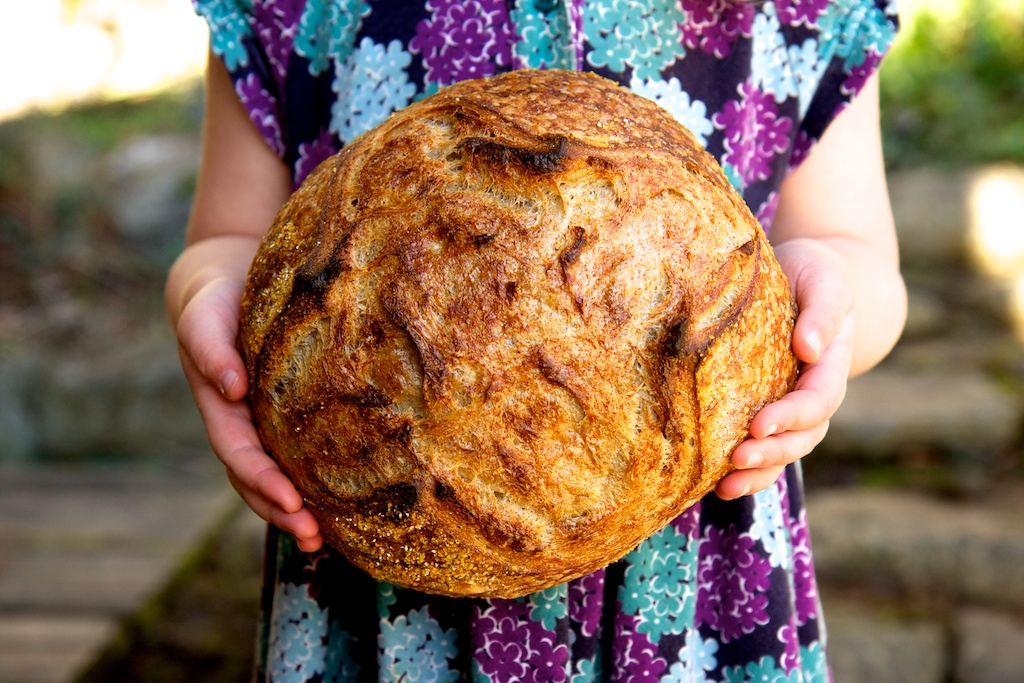
Here at Jones Ranch we get a twice-weekly delivery of the best bread we have ever eaten from our good friend and Orcas Islander Heather Immoor.  Heather landed on Orcas a few years back after a decade and a half bouncing around the broader culinary world.  After a year's stint opening the Catkin Cafe, Heather retreated to her mountain-top redoubt to have a second baby and bake bread.  Dubbed "Hedder Bread" by our 4 year old, deliveries are the most anticipated event of the week here--sometimes the loaves don't even make it inside from the van--hungry young Joneses will tear apart a full boule like a wolf pack taking apart a sickly caribou.  Heather's bread has a depth, crumb and authority like no other, and her crusts are always beautifully crusted and caramelized.  Weeks without Heather bread, such as immediately following the birth of her son, are dark and difficult time.  Heather's bread is truly superlative.  Now she is making the leap to bake and sell under health department discipline and we are delighted to promote, recommend and deliver "Hedder Bread" to the wider world.  


In Heather's own words.....
"What do you do after twenty years of professional cooking? You bake! After bouncing around the country in more restaurant kitchens than I care to count, two kids and island life have led me down a new path: the Path of Sourdough. Water, salt, flour, wild yeast beasties. After years of fascination and experimentation with the complexities arising from the combination of those four things, I'm finally devoting my daily life to the study of them. And the eating of them. Lots and lots of eating of them. We're pleased to bring you Endswell Bakehouse, a microbakery that, come spring, will be turning out a range of sourdoughs and other goodies to fill Island bellies. Retail customers can look for us at the Orcas Island Farmers Market, and restaurants and others interested in wholesale inquiries can find us at heather.immoor@gmail.com (until our website emerges from the dust of construction). Endswell Bakehouse: All's Well."

God Speed, Paisley Madison!!


After a year and a half of representing JFF in Seattle, Paisley is moving on to other endeavors.  We have appreciated her persistence, dedication, cell phone skills and flare.  Thank you, Paisley! you will be missed!

Place Your Orders Here.
For the time being Ma and Pa Jones will be fulfilling sales duties.  In the weeks to come we will be making personal contact with each of you.  Do not hesitate to reach out to us.  Sara may be reached at 360-468-0533 or orders@jffarms.com.  Nick may be reached, when off-island, at 360-298-5407 or ns@jffarms.com.  
AND TEXTING IS POSSIBLE FROM OUR REMOTE LOPEZ LOCATION, LET US KNOW IF YOU PREFER TO SEND ORDERS VIA TEXT AND WE CAN SET YOU UP WITH OUR 'EMAIL-TO-TEXT' OPTION.
Until next time, we are your Scallop Cake-Walking, Rock Fish Low-Balling, Slime Exuding, Bread Eating, Post-Paisley JFF Crew.  Just a call or e-mail away!!

Wednesday, March 9, 2016

Fish-O-Gram! Lent Supports Fish Consumption! Increase in Crab Quota! Halibut Countdown! Scallop Update! Fluke Frenzied RI Fishermen! Fresh Island Meats! Ask the Fishmonger!!

http://www.catholicmannight.com/wp-content/uploads/2013/02/jesus-simon-fish.bmp

We aim to be fishers of chefs.


With all the hubbub over Chinese New Year and the dawning Year of the Monkey, we allowed Lent to begin unnoticed and unsung in the Fish-O-Gram.  This week, we correct the oversight.  Lent officially began this year on Ash Wednesday, February 10 and ends on Holy Thursday, March 24.  During this time Catholics are strictly forbidden to eat meat on Fridays.  Too, they are encouraged to give up specific foods and generally challenge themselves with prayer and abstentions.  Years back Catholics were supposed to forego meat every Friday, not just during Lent. This changed in 1966, when Pope Paul VI issued a decree delegating responsibility for fasting schedules to national conferences of Bishops.  Shortly thereafter Americas Bishops met and rescinded the requirement for year-round meatless Fridays, though they did ask that Catholics replace fish Fridays with some other form of penance.  This sparked a years-long swoon in fish pricing.  These facts are well known. 

Less widely trumpeted is the importance of Rome-Mandated fish eating in developing global trade and settling the Americas.  It is no accident that Christopher Columbus, an Italian/Portugese man sailing under the Spanish flag, was the one to discover the new world. Earlier Norse and Celtic visitors to the New World were also seeking fish, from Leif Erickson to John Cabot.  As much as Gold and Glory, or Silk and Spice, Columbus was chasing fish, and he was doing so at the behest of his God and his Church.

Popular wisdom has it that the Catholic Hierarchy made a deal to boost fish sales centuries back--that meatless Fridays are another cheap deal from the golden age of Vatican corruption--This makes a great story but is untrue.  Fish have been a staple of feasts since time began and have always represented elevated spiritual virtues--clean, stoic, free-swimming and removed from the muck and muddle of humanity, as opposed to the generally squalid lives of livestock raised side by side with the generally squalid lives of early-day farm-folk.  Fish have much lower instances of deformities and parasites than livestock and wild game--mostly because underwater life is so consistently brutal that any sub-prime fish specimens are quickly eaten by something larger.  It is well known fact of ethnology that fish-oriented cultures world wide have been cleaner and more culturally advanced than farming or hunter types--compare Northwest Coast Natives or the Japanese with the Mongols or Russian Peasants.

As the Christian church developed, fish were the obvious feasting/fasting food.  Plus, Jesus himself made a distinct point of seeking out fisherfolk during his time here.  Recently this connection has led many in the fishing industry to cast our ongoing political and regulatory struggles in biblical terms.  Your Fish-O-Gram writer's first pickup truck had a "Jesus Was A Gillnetter" Bumper Sticker.  This sentiment reached it's peak in 1996, during the battle against an initiative that would have banned commercial fishing in Washington State.  Sanctified Seattle Gillnetter John Macdonald called into a Christian sport fishing radio program to declare that "Jesus would rip your head off" to anyone who voting to put the fishermen out of work.  I-640 went down in flames, 20 years later we are still fishing and the misguided, anti-fishing forces have been left to repent at leisure--no heads have been ripped off.  Mercy in action.

 https://www.pixoto.com/images-photography/transportation/automobiles/jesus-was-a-gillnetter-56125282.jpg

Words to live by

Fish represent both a Penance and a Good Work-- eating fish is good as a negative--eating fish means not eating meat, a sacrifice, and a positive--eating fish is a virtue, in and of itself, like charity and piety.  As of 1000 AD, more or less, Meatless Fridays became a requirement for the faithful--eating meat on Friday was considered a mortal sin on par with adultery and gossip-mongering.  This presented real problems for those not lucky enough to live on a coast.  Satisfying land-locked Catholics required a well-oiled trade in some form of preserved fish.  As discussed in a previous Fish-O-Gram, the church allowed for some artful end-runs for those in places too far removed from trade routes, most notably dispensation for Conquistadors to eat Capibara and Beaver in lieu of fish.  Fish do not preserve equally--the stand-out fish for preservation regard is Cod.  Cod is not found in any real numbers near the southern Catholic population centers, so an extensive trade route developed to tie Cod-producing northern regions to Cod-consuming Southern regions.  More often than not the return leg of the trip carried alcohol from the vineyards and distilleries of Central and Southern Europe.  Traders off-loading salt cod in Portugal filled their holds with the cheapest, nastiest rotgut they could find for the return voyage.  By the time the ship returned to Norway, Iceland or the Faroes, months of agitation inside oak casks had mellowed and improved the liquor through aeration and oxidation of the volatiles.  Grateful Nordic fishermen flavored the spirits with moss, reindeer droppings and botanicals and drank themselves stupid.  Fish trade, driven by the Catholic church, led to phenomenal improvements in transportation, navigation and logistics technology, not to mention Nordic alcoholism.  These advances, and the ongoing search for fish-rich grounds led directly to the discovery and colonization of the New World.

It'll be there by Friday.

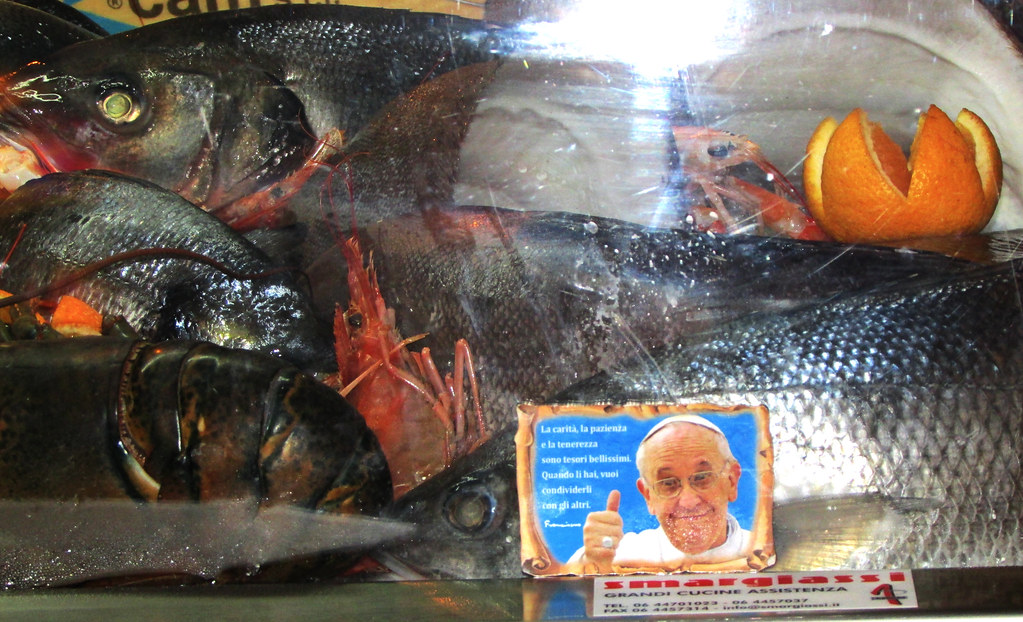
While Catholics represent just 1/4 of the JFF crew, we love Pope Francis.  These blustery, long last weeks of winter are a perfect time to reflect on god and man, the nature of life and our place in the world.  We like to think there is room within the Fish-O-Gram format for more than just the tawdry nuts and bolts of protein commerce. 

This years' Lent message from the Pope is "I desire mercy, and not sacrifice”   This seems a valuable thought for all, regardless of denomination.  And if focusing on fish helps sweeten the soul and concentrate the mind, so much the better. 

JFF Salutes Pope Francis!   

https://c1.staticflickr.com/9/8599/16714781191_621ce7dff6_b.jpg

A man for all Seasons. 

Local Fisheries Updates

https://blogger.googleusercontent.com/img/b/R29vZ2xl/AVvXsEha60E7oJMoWQwIGbyaHmRZoSncYeCOKDwooUUjwzbbjz6lgtgtKSDaTRBo5jj_IE8IJVPqRhFNpBBocxEiGSdQZGeAhYSs-FpxYsQ-llSfgIUkdb7exoidf43hh1i9mwSy3do_VG2x28Wa/s1600/halibut+196kg+big+huge+world+record+igfa+giante+pesce+biggest+fishes+fish+of+the+world+pesce+enorme+gigante+big+fishes+of+the+ocean+of+the+sea+big+fish+of+the+world+best+images+norway+atlantic+dintur.jpg

March 19th- Livin' the dream!

Tribal Halibut continues to be scheduled for March 19.  We have begun securing bait and locking down arrangements with our fisher friends.  Big Fun!!!  Also, happily, we have also secured a bottomless market for skate wings.  Skate come in along with the halibut in huge numbers--last year our primary folks at Lummi got 20,000+# and we, frankly, were swamped. Seems the skate market in Korea is red hot right now and we've got a container to fill.  Moving Skate is slimy, caustic and nasty--but it represents fuel money for the guys and is part of our service as fish buyers.  So, here's skating clean, all the way to Seoul!  Halibut will be available in Seattle beginning the morning of the 20th, weather permitting.  ORDER NOW!!!!! Remember, our San Juans Halibut are the best in the world, cradled in North America's beauty spot, raised on a steady diet of Spot Prawns and soft Dungeness Crab.  Don't get stuck with the inferior Alaska or Coastal product, Call Paisley now!  Two years ago Elliots got a 240# halibut caught by Ilya Joy of Lummi.  There are monsters down there!


The Lummi Nation went fishing and all we got was this creepy skate. 

Dungeness Crab

Continuing the general upward swing of our in-sound fisheries, WDFW just bumped the Puget Sound Crab Quota by 180,000#, split between tribes and state fishers.  This is on top of the already allocated and harvested 5,000,000#.  A trickle of beautiful, hard-shelled crab come in daily.  Fishers report their traps are stuffed with huge numbers of soft-shelled crabs just coming into legal harvest size.  So we have abundant hard crab for another six weeks or so, though the price is getting a little stiff.  And next summer for the sport and tribal fisheries should be as good or better than last years' superlative fishing.  Come visit for a crab-themed Island get-away!

Pink Scallop Update--Department of New Horizons

Last week was the best weather week of the 2016 so far.  We had high hopes, but our divers did not make it out.  Divers are the sauciers of the fisheries world and we are finding that we have zero control over their behavior.  As those lucky few of you who got teaser bags of scallops may have noticed, we have jumped the price to you so as to sweeten the price to the divers.  Our hope was that a higher price would be a nice carrot for the divers, but it seems we need a bigger stick of some kind.  And now the weather has turned, so we are least a few days out from any serious attempts for scallops.  Joe Stephens, our superstar dive master, is on the prowl for more divers.  Diving is the perfect job for water-loving urban refugees.   If you are tired of the Seattle culinary bump-and-grind, consider trading your apron and knives for a wetsuit and butterfly net.  No tipping--pay is by the pound.  Joe will train! Celebrity Chefs welcome to apply! 
With your help pink scallops will become a regular, week by week product.  

https://s3.amazonaws.com/s3images.classcreator.com/13888/001/2701462/1572609.jpg

It's better down here. 

Land Ho!

Excellent Fresh Meats are rolling out from the knife-wielding wizards at Link Lab.  Call Paisley or Sara to build a fresh meats program for your needs.  We have regular supplies of Lopez Lamb, Lopez Pork and Lopez and Skagit Beef.  

All meats are from Jones Ranch or specified, equivalent producers.  Come see the magic happen at Link Lab.  The LL boys are on fire! Go Jerry! Go Jesse!

Remember, the difference is in the Grass and in the Cutting.  

Give Me Fluke or Give Me Beer.

Attentive Fish-O-Gram readers will have noticed a tapering in Eastern fish abundance and variety these past weeks.  This is because the Rhode Island Fluke season is in full tilt and Pt Judith fishermen are in full blown Fluke Frenzy.  Everything else has fallen by the wayside, laundry is piling up and huge volumes of fluke are making their flatfish way to markets near and far.  That said, we do have Monk, T&T, John Dory and Black Sea Bass coming in for the end of the week.  Call Paisley.  Oh, and if anyone wants some, Fluke is extremely available.  On the East Coast Fluke are considered a prime animal--often used for sushi.

  http://www.southcoasttoday.com/storyimage/NB/20140427/NEWS/140429929/AR/0/AR-140429929.jpg

Why Doesn't Seattle Love Fluke?

Chef Call-In Corner

The most common questions we field are about fish freshness.  You, our customer base, demand the best, and it is our delight to provide you the best.  What the best means though, is a rolling notion, particularly when it comes to fish freshness.  For many of you, the below information will be old hat.  But it needs to be written. 

One fish, fresh fish, firm fish, blue fish. 
When it comes to freshness, the fish-by fish variations can be devilishly complex.  Not all fish are created equal, even within species, and any natural attributes of the fish can be mitigated or compounded by harvest type and handling.  The primary variables impacting fish freshness are fish variety, harvest methods and post-harvest handling.  

Hot Belly/Cool Belly
As with any living organism, guts, blood, slime and organs will deteriorate much faster than flesh.  Predatory fish, midwater fish, being high-metabolism, as opposed to herbivorous fish or low-metabolism bottom-dwelling fish, suffer with the rapid breakdown of prey fish in their bellies.  The principle is exactly like a compost pile--flesh in a digestive tract is "hot" and greenery is "cool".  A hot digestive tract can burn through the intestinal lining and begin to degrade belly flesh within a few hours after a fish dies.  Belly burned fish will have discolored belly meat and dissolved pinbones.  In extreme cases, the entire belly can be ruined.  Ice slows the process down, but does not stop it.  The best thing for hot bellied fishes is immediate gutting and ideally bleeding as well.  Degree of chilling is also all important.  The closer to freezing the fish gets, the better it will hold up.  Most fisheries ice is made with salt to lower the ice temperature.  A little salt in the ice also help to draw out slime, which is highly volatile. 

Smaller and midwater fishes tend to have short shelf-lives.  Small oily fish, like sardines and mackerel  and squid, have very short shelf lives.  This is why so much of these fishes are frozen.  An issue with small "wetfish" (sardines, squid, etc) is that they are too small to efficiently gut on board and so, regardless of icing, they generally need to be prepared within a week of harvest. 

Salmon tips
Coho salmon is the most volatile salmon, followed by King.  That is a major part of why these fish have traditionally been caught by trollers--there is no particular magic in line catching fish--actually, line playing a fish can release large amounts of lactic acid in the flesh.  Trollers catch fish in small enough volume to bleed and gut them immediately after harvest.  Nowadays progressive trollers slip a charged catheter tube onto fish livers and flush blood out of the entire fish.  Sockeye, by contrast, as herbivores, can sit for extended periods with their guts in with no degradation of the fish.  This is why gillnet caught sockeye is the best sockeye there is--gillnets are a nice, gentle way to die, and while it is always better to gut fish right away, it doesn't absolutely need to be done.  Gillnetters who bleed and dress fish in the Troll fashion produce some of the finest salmon, of all species, of anyone on the water.  In any case, the quality of handling from harvest onward is much more important than chronological age.  Trollers routinely fish for up to ten days between deliveries.  As long as the fish have been fully cleaned, amply iced and lovingly handled, there is no problem with shooting ten day old fish into the supply chain.  They will remain premium for at least another ten days.  Summertime on the rivers here the tribal fishery generally goes forth with minimal ice and rough handling.  A river king salmon tossed in an open skiff, not iced and not dressed, may be inedible within a few hours, while we would have no problem recommending a 20 day old troll king.  The other variable is proximity to spawning grounds and diet--again, an ocean-caught salmon will be flawless and can hold up much longer in transport, while an inshore-caught fish is more likely to be already degraded as it prepares itself for spawning.  Purse Seine caught salmon tends to be the softest, based on the violence of the harvest and the volumes typically caught at one time. 

Bottoms Up
Most bottom fish tend to hold up fairly well.  This is partially a function of their slower metabolism.  Here again, harvest method is critical, with drag-caught fish getting scuffed up before hitting a boat deck.  We do our best to not source drag-caught fish for this reason.  Hook and line or pot caught is better, especially for higher value species like black cod, pacific cod and monkfish, as these are gutted onboard.  Our Rhode Island Friends also catch some bottomfish in fish traps and this fish has proven to be uniformly excellent.  Rhode Islands fishers also use gillnets for some bottom species.  This is how most of the monk and dory is caught.  Again, gillnets are gentle, and the high value of these fishes means post-harvest handling is excellent.  This does vary widely by species.  One common Eastern flatfish used to be known as the Baptist Flounder, always thrown back because it invariably goes bad shortly after coming out of the water.  For the most part fishes that are transported long distance or held for extended times are fishes that can hold up to this.  Fishes that cannot are frozen or rendered.

Age can be a good thing.
Some fish, like Halibut, actually improves as with age.  The old-time schoonermen would make 20-40 day trips from Seattle to the Bering Sea for fresh halibut.  Fishing would commence and fish would be layered, with ice, until the holds were full.  Upon unloading, returning crewmen considered the earliest, lowest fish in the holds to be the premium fish for homepack.  Aged halibut develops a wonderful round, buttery flavor.  My first season in Alaska we forgot about a half-halibut in a side hatch for three weeks.  When rediscovered the fish had turned yellowish and had plumped up from the salt and ice.  It had a strong, but not unpleasant aroma, kind of like a mellow hard cheese.  Cooked it was delicious, vastly superior to the sqeaky-fresh fletch we had cooked the night we caught it.  Salmon is the same, though the squeakyness of too-fresh salmon fades much more rapidly.  Sturgeon and some varieties of Eel don't even stop twitching for 3-4 days post harvest.  During this time they are literally inedible, assuming you can even pin one down to cut it. 

http://halibutassociation.org/halibutpix/Dorothy_schooner.jpg

I'll take the one on the bottom.

The Supply chain is What it is. 
Barring truly heroic efforts or a great stroke of luck, fish doesn't come much fresher than 5 days or a week old.  Between the ups and downs of weather, timelines of fishing, shore handling and the world of logistics, this is just the way things are.  When we have fresher fish, we heavily advertise that fact.  Even there, farm fish is generally at least a week old, based on processing and transportation limitations.  Most fish in grocery stores is at least ten days old. This should not be a problem if the fish has been well handled, and should allow for 5-6 days in a customer's home.  Some fresh fishes like sardines move on a more streamlined basis because they have to.  This is one reason fresh wetfish rarely turns up on retail counters.

Shellfish Guide.Shellfish are a giant exception to these guidelines.  When it comes to shellfish, the fresher the better.  This is why we pull shellfish fresh from the water early mornings on delivery days, not from a warehouse.  Accept no substitutes!

It's Not the Days on the Fish, it's the Bruises, Hands and Temperature.  Our Campaign Promise.
Fish should look good, smell good and be free of bruises and blood.  If those conditions apply, age is pretty much irrelevant.  Unlike many distributors, we will always tell you what we know about fish origins.  Dealing with variable aged-product is an inherent part of working with wild fisheries.  We ask that you evaluate the fish on it's merits rather than chronological age.  Also we encourage all of you to put some of the local halibut aside, nice and cold, for 3-4 weeks as culinary experiment.  It will have the properties of a finely aged steak, only better, because it is fish. 

We are, your finely aged, only mildly bruised, JFF Crew. 


Tell it like it is.